
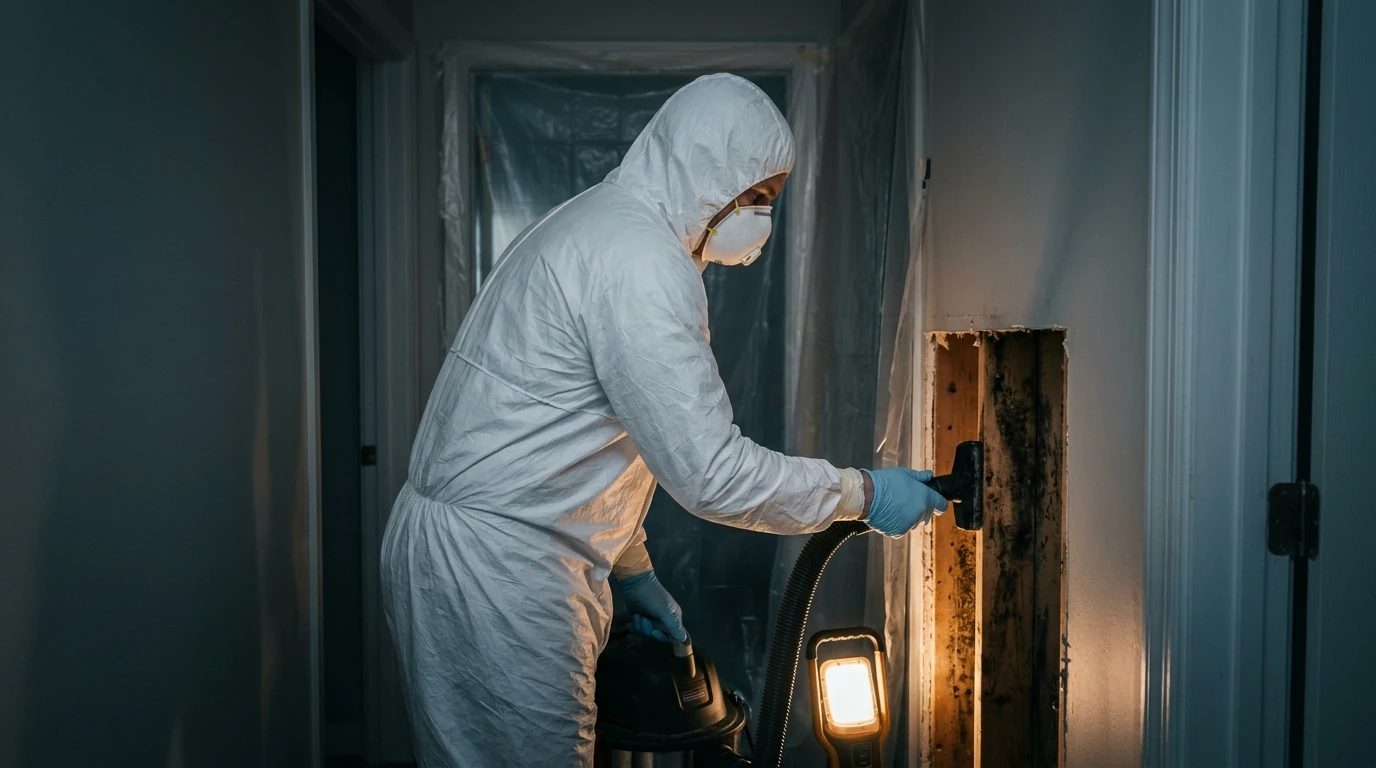
TL;DR: Mold behind drywall in Royse City calls for a licensed mold remediation company, not a DIY wall cut. If you see staining, bubbling paint, or a musty smell near a past leak, get a certified remediator to assess it before anyone opens the wall. Texas requires an independent licensed assessor once the affected area tops 25 square feet. Containment keeps spores out of the HVAC system while the drywall comes out, the framing dries, and the wall goes back together.
You’ve got a musty smell by the baseboard, a water stain that keeps bleeding through fresh paint, or a soft spot in the drywall near where a supply line once leaked, and you’re standing there with a utility knife deciding whether to just cut it open and look. Don’t, not yet. For mold behind drywall in Royse City, call Reign Restoration at (214) 304-0621. The crew holds IICRC AMRT mold certification and carries a Texas mold remediation license (MRC2276), which matters here because Texas is one of the few states that actually licenses this work.
Who should you call first for mold behind drywall?
Call a licensed mold remediation company before you call anyone else, including a handyman with a crowbar. Cutting into a moldy wall without containment releases spores into the air you’re breathing and into the HVAC return, turning a one-room problem into a whole-house problem.
Texas regulates this more than most states do. Once the suspected mold-affected area is more than 25 contiguous square feet, state rules generally require an independent, licensed mold assessor to test and scope the job before a separately licensed remediation contractor touches it, a conflict-of-interest safeguard built into the Texas Department of Licensing and Regulation’s mold rules. Reign Restoration’s crews work within that framework rather than around it; you can confirm any Texas mold license directly through TDLR’s license search.
If the drywall is wet right now, a visible leak is still running, or you can hear water, the first call is actually to stop the source: a plumber, or a water leak detection specialist who can pinpoint a slab or slow pipe leak without tearing out walls to find it. Mold remediation comes right after the source is confirmed stopped, not before.
What happens when you call?
The first call is a quick phone triage: how old is the staining, was there a known leak, is anything actively wet, and is anyone in the home dealing with respiratory issues or asthma. That determines how fast a tech needs to get out and whether containment goes up same-day.
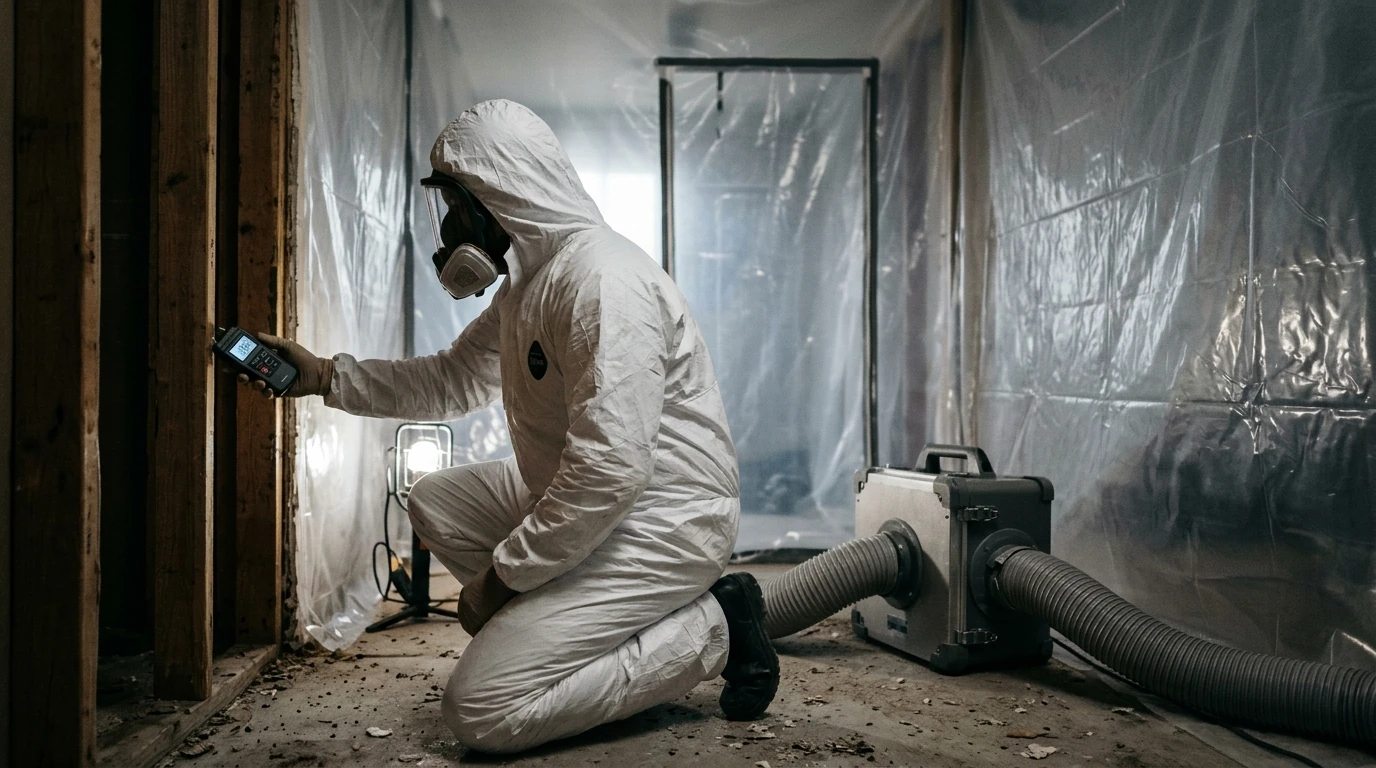
On arrival, the first tool is usually a moisture meter, not a saw. A tech checks the wall cavity’s moisture content and maps how far it extends, because mold rarely stops exactly at the stain you can see. If the area clears the 25-square-foot threshold, assessment and sampling happen before any cutting starts, consistent with EPA guidance on mold cleanup and the IICRC’s S520 mold remediation standard.
Once the scope is set, containment goes up first: poly sheeting sealing off the work area and negative air pressure pulling air through a HEPA filter, so spores don’t travel into the rest of the house while the wall comes open. Only then does the affected drywall get cut back to clean material, bagged, and removed. If the leak traced back to plumbing, that gets repaired or re-routed before anything new goes back up.
Does mold behind drywall always have to come out, and who rebuilds it?
Affected drywall almost always comes out rather than gets cleaned in place, because drywall’s paper facing holds mold growth in a way a wipe-down can’t fully reach. Framing and studs can often be treated and dried instead of replaced, if the wood itself tested structurally sound.
This is where the job stops being a demo project and starts being a rebuild. Once the cavity is dry and clearance testing confirms the space is clean, new drywall, insulation where needed, tape, texture, and paint go back in. Reign Restoration’s general contracting and reconstruction crews handle that phase directly, so the same company that removed the moldy material is the one putting the wall back together, with one point of contact instead of three subcontractors passing the job around. If the wall damage ties back to an older water event, the site’s drywall repair after water damage guide covers that rebuild sequence in more detail.
Who pays to replace moldy drywall?
A homeowners policy typically covers mold removal and drywall replacement only when the mold grew from a sudden, covered event, like a burst supply line, not from a slow leak that sat for months. Insurers draw a hard line between sudden and gradual, and that line decides the claim.
Documentation from the moisture assessment, the source repair, and dated photos of the contained work all support a claim built on a sudden-loss story. If the leak was gradual or went unaddressed, expect the remediation and rebuild to be an out-of-pocket job, which is also why getting a tech out as soon as you notice a stain protects both your home and your claim.
If you’re staring at a stain right now and debating whether to grab a utility knife, put it down and request a mold assessment instead. A quick look with a moisture meter tells you in minutes whether this is a one-panel fix or something that needs containment, and that answer is worth more than a guess made through a hole in the wall.
About Reign Restoration
Reign Restoration is an IICRC-certified firm (WRT, AMRT, FSRT) serving Royse City, TX and the greater Dallas area since its founding, holding Texas mold remediation license MRC2276. The company handles mold remediation, water damage restoration, fire and smoke restoration, storm damage, and the reconstruction and general contracting work that follows, with 24/7 availability for active water or mold emergencies across Rockwall, Greenville, McKinney, Plano, and the surrounding communities.
Need help now? Call Reign Restoration at (214) 304-0621.