
24/7 Emergency Water Damage Restoration in Royse City
24/7 emergency water damage restoration in Royse City and surrounding areas. IICRC-certified, insurance billing accepted. Call (214) 304-0621.
Water damage emergency in Royse City? We answer 24/7. Call now and our crew heads out to stop the water and start drying your property.
You notice it first as a soft give underfoot, the subfloor has absorbed water you didn’t know was there. Or you come home to the sound of a running appliance that stopped running hours ago, and now there’s a half-inch of standing water spreading across your kitchen tile into the hallway carpet. Water moves fast, hides in wall cavities, and begins breaking down drywall, wood framing, and adhesives within hours. The window to stop secondary damage, and the mold that follows 24 to 72 hours after saturation, is narrow. That’s exactly what water damage restoration is designed to close.
What water damage restoration actually involves
Water damage restoration is not mopping up and running a box fan. It’s a structured, equipment-driven process that tracks moisture through building materials, not just the surfaces you can see. After a supply line burst, an appliance failure, or a roof intrusion, water migrates horizontally under flooring and vertically through wall assemblies. Drywall wicks moisture upward. Insulation traps it. Hardwood flooring cups and buckles as the moisture content climbs.
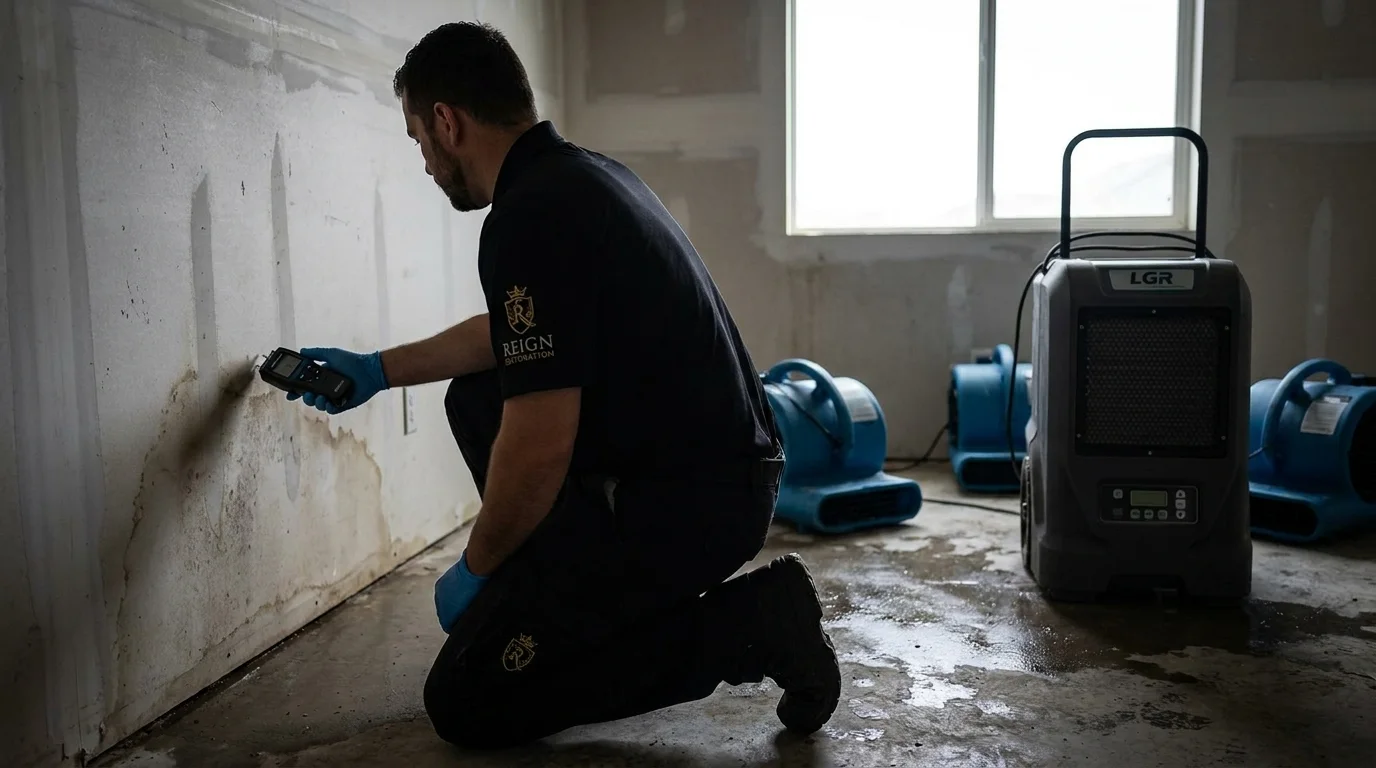
Professional water removal starts with truck-mounted or portable extractors capable of pulling hundreds of gallons from carpet, padding, and subfloor before any drying equipment is placed. From there, the job shifts to structural drying: commercial-grade low-grain refrigerant (LGR) dehumidifiers and high-velocity air movers are positioned to create a controlled drying environment. Moisture readings are logged at every affected surface, walls, floors, ceilings, using penetrating and non-penetrating meters and thermal imaging cameras that reveal wet zones invisible to the eye.
For Category 2 (gray water from appliances or overflows) or Category 3 losses (sewage, floodwater), containment and antimicrobial treatment are added to the scope. The water classification matters because it determines how materials are handled, what PPE technicians wear, and what your insurance adjuster will expect to see documented.
A typical residential water mitigation job runs 3 to 5 days of active drying, though slab-on-grade homes, thick hardwood floors, and losses that sat undetected for more than 24 hours can extend that timeline.
Our process
-
Emergency inspection and moisture mapping. A technician arrives, identifies the water source, and stops active intrusion if it hasn’t been stopped already. Thermal imaging and moisture meters establish a baseline across every affected room, this documentation is the foundation of your insurance claim.
-
Water extraction. Standing water is removed first using truck-mounted extractors or high-capacity portables. Carpet and padding are evaluated; padding is almost always non-restorable and removed at this stage. Hardwood floors are inspected for cupping and may require specialty drying mats or floor drying systems.
-
Structural drying and containment setup. LGR dehumidifiers and air movers are placed per the IICRC S500 standard drying calculations, equipment isn’t just scattered around the room, it’s positioned to move air across wet surfaces and into the dehumidifier’s intake. For Category 2 or 3 losses, plastic containment barriers and negative air pressure limit cross-contamination.
-
Daily moisture monitoring. A technician returns each day to log moisture readings, reposition equipment as materials dry, and document progress. Drying is not complete until affected materials reach acceptable moisture content, not when the equipment has simply run for a set number of days.
-
Final documentation and scope handoff. When materials reach dry standard, a final moisture report is compiled. If any materials, drywall, insulation, flooring, could not be dried in place and require removal and replacement, that scope is documented and handed off to the reconstruction phase.
What separates a good water damage response from a bad one
The most common mistake in water mitigation is treating it as a surface problem. Running a consumer dehumidifier in the center of a room does almost nothing for moisture trapped inside a wall cavity or beneath a glued-down floor. Technicians without moisture meters are essentially guessing, and what they miss becomes mold in three weeks.
A second failure point is misclassifying the water source. Category 1 (clean water from a supply line) and Category 3 (sewage backup or groundwater) require completely different handling protocols. Treating a sewage loss like a clean-water loss is a health hazard and will be flagged by an experienced insurance adjuster reviewing the scope.
Insurance adjusters look for a written moisture log with daily readings, a clear water classification, photo documentation of affected materials before and after extraction, and equipment placement records. Without that paper trail, supplements and disputes become much harder to resolve. Reign Restoration holds an IICRC WRT (Water Restoration Technician) certification and operates as an IICRC Certified Firm, which means the documentation standard is built into the process, not assembled after the fact.
What does water damage restoration cost?
Typical costs depend heavily on the size of the affected area, the water category, how long the water sat before mitigation began, and whether materials need to be removed. Most homeowners pay somewhere between $1,500 and $8,000 for mitigation alone; losses involving multiple rooms, finished basements, or contaminated water run higher. The table below reflects typical industry ranges, not quotes from Reign Restoration.
| Scenario | Typical industry range |
|---|---|
| Single room, Category 1 (clean water), caught quickly | $1,200 – $3,500 |
| Two to three rooms, Category 1, minor wall involvement | $3,000 – $6,500 |
| Category 2 (gray water), appliance or toilet overflow | $3,500 – $8,000 |
| Category 3 (sewage or groundwater), single area | $5,000 – $12,000 |
| Finished basement, any category | $4,000 – $15,000+ |
| Hardwood floor specialty drying (per room) | $800 – $2,500 |
Every loss is different, and Reign Restoration provides a written scope of work before any billable work begins. Standard homeowners insurance typically covers sudden and accidental water losses, a burst pipe, appliance failure, or roof leak, but excludes gradual leaks and most groundwater flooding (which requires a separate flood policy).
Seasonal and regional considerations
Royse City and the broader Rockwall and Hunt County area sit in a climate zone where hard freezes arrive fast and without much warning. Homes built on slab foundations with exterior pipe runs, common in subdivisions developed quickly during the area’s growth boom, are especially vulnerable to freeze-thaw pipe bursts in January and February. A single night at 18°F can split a half-inch copper supply line and push 50 to 100 gallons into a wall before anyone notices the pressure drop.
Summer brings a different risk: the combination of high ambient humidity (routinely above 70% dew point from June through September) and aggressive air conditioning creates condensation conditions inside wall assemblies, particularly in homes with vapor barrier issues or recent HVAC duct repairs. Water that enters during a summer storm has less margin before mold colonization begins because the baseline spore count and humidity are already elevated.
Service area
Reign Restoration is based in Royse City, TX, and serves water damage losses across the surrounding region, including Rockwall, Fate, Heath, Forney, Terrell, Caddo Mills, Greenville, and the broader Hunt and Kaufman County areas. The city-specific pages for each community link back here for the full technical detail on how water mitigation works.
If you’re standing in a wet room right now, call (214) 304-0621 to schedule your moisture assessment, the sooner readings are established, the clearer the path to a dry, documented, and properly closed loss.
Services We Handle
- Carpet Water Damage
- Carpet Water Extraction
- Ceiling Water Damage Repair
- Commercial Restoration
- Flood Restoration
- Hardwood Floor Water Damage
- Laminate Floor Water Damage
- Water Damage Cleanup
- Water Damage Cleanup Repair
- Water Damage Flooring
- Water Damage Repair
- Water Damage Under Flooring
- Water Leak Detection
- Water Mitigation
- Wet Drywall Repair
- Wood Floor Water Damage Repair
Frequently Asked Questions
Does homeowners insurance cover water damage restoration?
How long does structural drying take, and what affects the timeline?
What's the difference between Category 1, 2, and 3 water, and why does it matter for cleanup?
Can hardwood floors be saved after water damage, or do they always need to be replaced?
What should I do — and not do — while waiting for the restoration crew to arrive?
Looking for the best water damage restoration company in Royse City?
Reign Restoration provides licensed and insured water damage restoration in Royse City, TX and the surrounding area. Customers rate us 5.0 out of 5 stars across 27 Google reviews. We answer calls 24/7 — call (214) 304-0621 for immediate help.
Need Water Damage Restoration now?
We respond 24/7 across Royse City and surrounding TX cities.
Related Coverage
- Our Restoration Services
- Contact Reign Restoration
- 24/7 Emergency Water Damage Restoration in Fate
- 24/7 Emergency Water Damage Restoration in Garland
- 24/7 Emergency Water Damage Restoration in Greenville
- 24/7 Emergency Water Damage Restoration in Mesquite
- 24/7 Emergency Water Damage Restoration in Rockwall
- 24/7 Emergency Water Damage Restoration in Rowlett
- 24/7 Emergency Water Damage Restoration in Terrell
- 24/7 Emergency Water Damage Restoration in Wylie
- Burst Pipe Checklist: Step-by-Step Response
- What To Do in the First 24 Hours After Water Damage
- How To Choose a Restoration Company in (Without Getting Burned)