
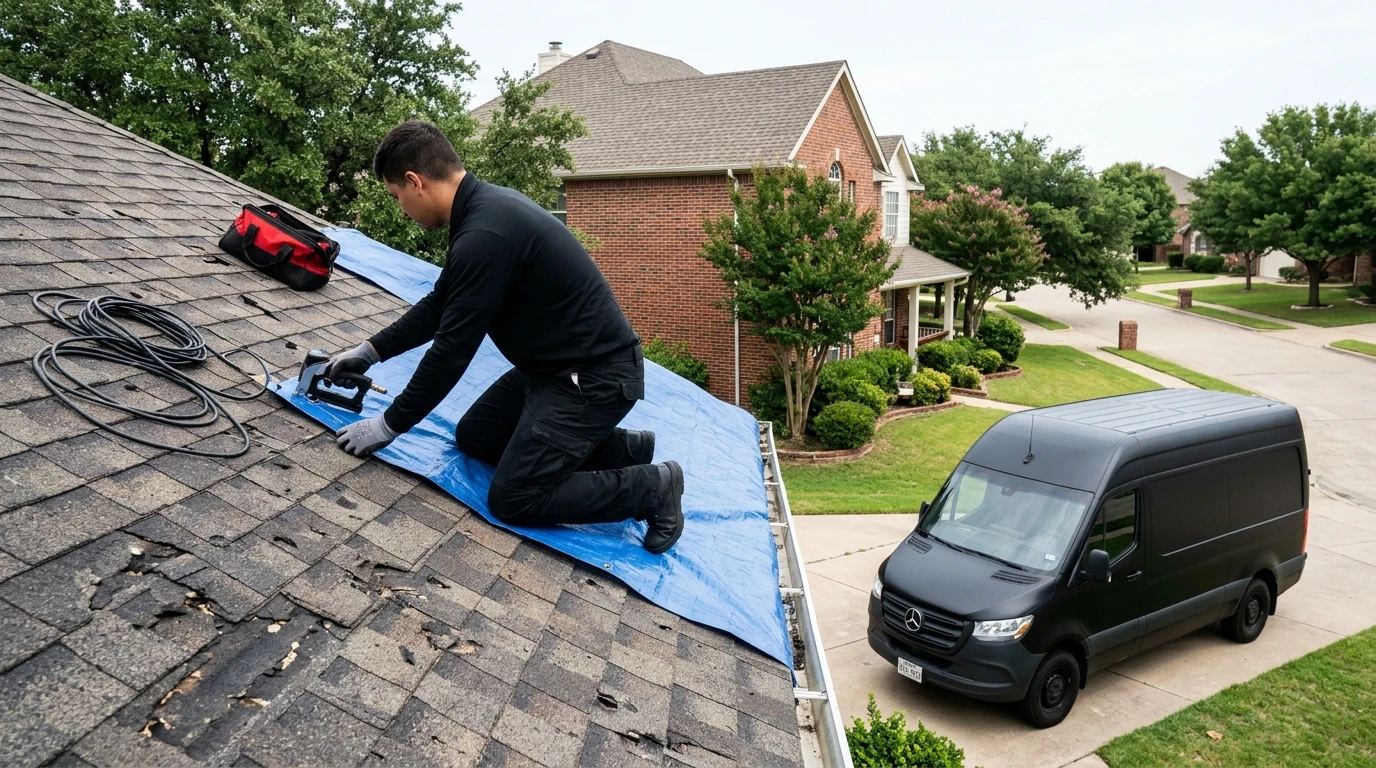
A hailstorm or straight-line wind event in Rockwall County rarely damages just one thing. The roof takes the first hit, then water finds its way through the breach, and now you’re looking at a claim that covers tarping, roofing, drying, and interior rebuild all at once. In Texas, a full storm damage restoration job, from emergency tarp to finished interior, typically runs $14,000 to $40,000 or more, with the biggest swing factor being whether the roof needs partial repair or full replacement and how much water got into the living space before the breach was covered.
This guide breaks the whole job into its real cost pieces so you know what you’re looking at before the adjuster does.
What does storm damage restoration cost in Royse City, TX?
Most whole-job storm claims in the Royse City area land between $14,000 and $40,000, with smaller single-room water intrusions on the low end and full roof-plus-interior rebuilds on the high end. The number depends on roof pitch and size, how long water sat before mitigation started, and how much drywall, insulation, and flooring has to come out.
A simple shingle patch with no interior water intrusion can come in under $5,000. A hail-damaged roof that needs full replacement, paired with a ceiling collapse and two rooms of wet drywall and flooring, is a different conversation entirely. The honest answer is: nobody can quote a storm job accurately without walking the roof and the interior first, which is why every legitimate contractor starts with a free inspection and a written scope, not a phone-quote number.
| Scope of work | Typical cost range |
|---|---|
| Emergency tarp and board-up, single-story | $450 - $1,500 |
| Multi-story or steep-pitch tarp-over | $1,200 - $3,000 |
| Partial hail-damaged shingle roof repair | $1,500 - $4,500 |
| Full roof replacement, average DFW home | $9,000 - $18,000 |
| Water mitigation after a roof or window breach (1-2 rooms) | $1,800 - $5,500 |
| Interior reconstruction: drywall, insulation, flooring, paint | $4,000 - $20,000+ |
| Whole storm claim, start to finish | $14,000 - $40,000+ |
For a deeper breakdown of roof repair versus full replacement pricing specifically, see our hail damage roof repair cost guide for Royse City, which covers shingle-by-shingle repair economics in more detail than we’ll go into here.
What actually drives the final number up or down?
Five factors move a storm job’s cost more than anything else: how fast the breach gets covered, how long water sat before extraction started, roof pitch and material, how much of the interior is affected, and whether code upgrades are triggered by the permit.
Response time matters more than people expect. A roof tarped within hours of the storm keeps the interior dry and the claim simple. A roof left open for a few days, even under a tarp that’s shifted in the wind, can turn a $2,000 ceiling patch into a $15,000 drywall, insulation, and flooring job because the water had time to travel into wall cavities and subfloor.
Roof material and pitch set the replacement baseline. Standard three-tab or architectural asphalt shingle on a typical pitch is the cheapest tier. Steep pitches, multiple stories, and premium materials (standing seam metal, heavier architectural shingle) push labor and material cost up before storm damage even enters the picture.
Interior scope depends on how much water intruded and for how long. Category 1 water (clean, from the roof breach before it touches ceiling material) is cheaper to mitigate than water that’s been sitting against drywall and insulation for days, which usually gets categorized higher and requires more material removal rather than drying in place, per the ANSI/IICRC S500 water restoration standard.
Code upgrades can add cost your insurer may or may not cover. If your roof deck or flashing doesn’t meet current code and the permit requires an upgrade during replacement, that’s sometimes a separate line item. Ask your adjuster directly whether your policy includes an ordinance-or-law endorsement before assuming it’s covered.
How does the Texas wind/hail deductible actually work?
Most Texas homeowners policies carry a separate wind/hail deductible, usually written as a percentage of your dwelling coverage rather than a flat dollar amount, and it applies instead of your standard deductible when the damage is caused by wind or hail. On a $300,000 dwelling with a 2% wind/hail deductible, that’s $6,000 out of pocket before your policy starts paying, which catches a lot of homeowners off guard when they assume their regular $1,000 or $2,500 deductible applies.
This percentage deductible is specific to named-storm and wind/hail coverage in many Texas and Gulf Coast-area policies. It’s worth pulling your declarations page and checking the exact percentage, since it ranges from 1% to 5% depending on the carrier and when the policy was written. The Texas Department of Insurance publishes guidance on how these claims are supposed to work, and your policy’s declarations page will state your specific percentage.
Separate from the wind/hail deductible, any interior water damage that results from the storm (a leak through the breached roof, for example) is typically evaluated under your standard dwelling coverage once the source is the covered peril, though every policy reads a little differently. See our guide on filing a water damage insurance claim in Texas for more on documentation and timelines, and the Insurance Information Institute’s overview of what homeowners policies cover for the national baseline most Texas carriers build from.
What does the restoration process actually look like, job to job?
A storm job runs in four phases: stabilize, document, mitigate, and rebuild, each one feeding the insurance claim as it happens rather than after the fact.
- Stabilize. Emergency tarp or board-up goes on first, same visit, to stop additional water and weather intrusion. This is the step that protects both your home and your claim.
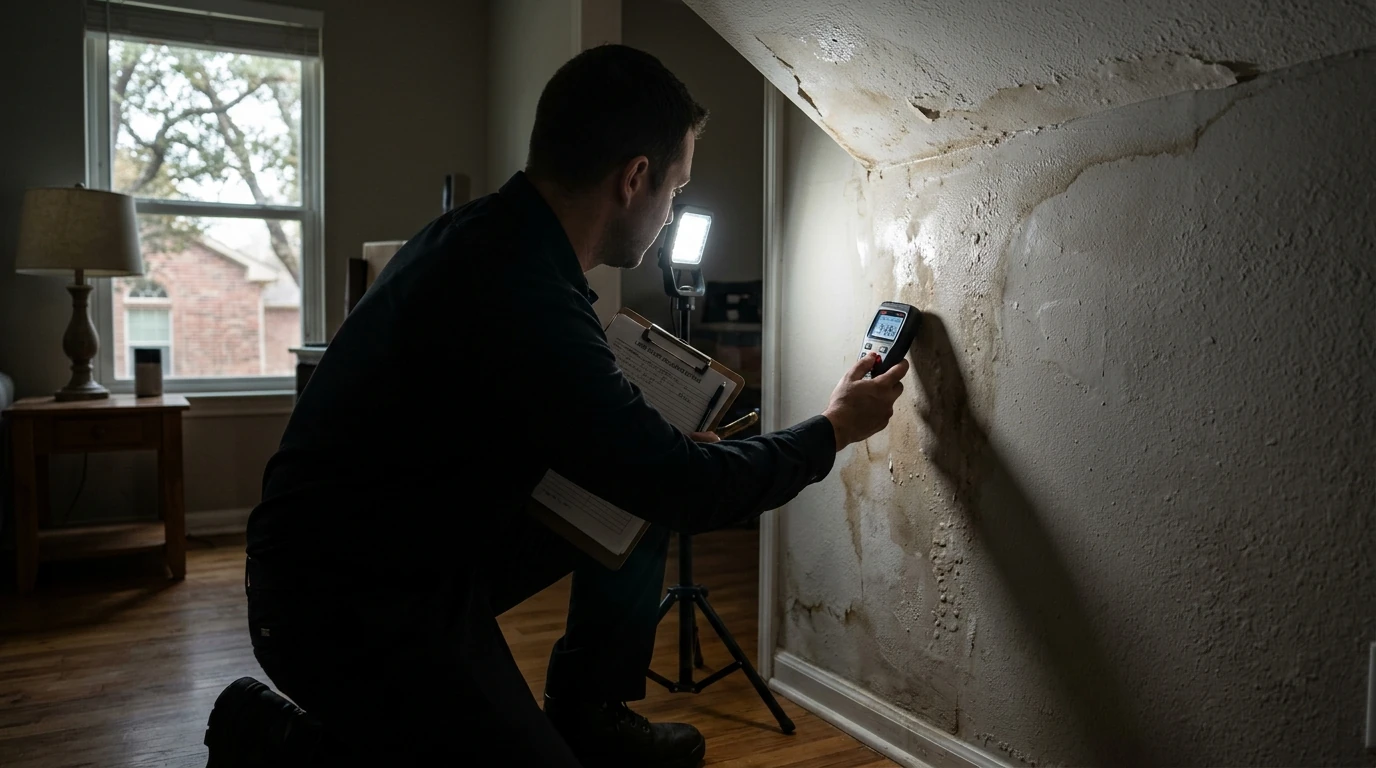
- Document. Photos, moisture readings, and a written scope get logged before any demolition starts. This record is what your adjuster uses to verify the loss matches the estimate.
- Mitigate. Standing water gets extracted, affected material that can’t be dried gets removed, and drying equipment runs until moisture readings confirm the structure is dry, not just until it looks dry.
- Rebuild. Roofing, drywall, insulation, flooring, and paint go back in, coordinated so the interior rebuild doesn’t start before the roof is weathertight.
Reign Restoration handles all four phases directly, which matters on storm claims specifically: when one company tarps the roof, documents the loss, dries the interior, and rebuilds it, there’s no handoff gap where details get lost between contractors.
What should you do first if your roof or home just took storm damage?
Get the breach covered and the damage documented before you call your insurer, not after. A tarp or board-up stops the loss from growing, and photos taken before any cleanup protect your claim regardless of who ends up doing the repair work.
If water is actively coming in, treat that as the priority over the roof shingles themselves; a soaked ceiling and wet drywall only get more expensive the longer they sit. Request a written scope and a line-item estimate before signing anything, and keep every receipt, including the tarp invoice, for your adjuster.
A storm claim moves fastest when the mitigation, the documentation, and the rebuild estimate come from the same team instead of three different ones. If a recent storm has left your roof open or your interior wet, schedule a storm damage assessment before the next rain event makes the job bigger than it needs to be.
About Reign Restoration
Reign Restoration is an IICRC Certified Firm serving Royse City, TX and surrounding Rockwall and Collin County communities, licensed under MRC2276 and available 24/7 for storm, water, fire, and mold emergencies. Their crews hold IICRC WRT, AMRT, and FSRT certifications and handle the full job, from emergency tarping and roofing through water mitigation and full interior reconstruction, so storm claims move through one coordinated team rather than several separate contractors.
Need help now? Call Reign Restoration at (214) 304-0621.
Video Transcript
A hailstorm in Royse City rarely damages just one thing, the roof gets hit first, then water quickly finds its way inside your home. A full storm restoration job, from emergency tarp to finished interior, typically runs fourteen thousand to forty thousand dollars or more. The biggest swing factor is simple: does your roof need a partial repair, or a full replacement, after the storm? How fast your contractor tarps the breach matters most, a roof covered within hours keeps water out of your walls. Roof pitch, material, and how long water sat before drying started all push the final number up or down significantly. Texas wind and hail deductibles work differently, they’re often a percentage of your dwelling coverage, not a flat dollar amount. On a three hundred thousand dollar home, a two percent deductible means six thousand dollars out of pocket before coverage starts. Good documentation, photos, moisture readings, a written scope, helps support your claim when you talk with your insurance adjuster. Every legitimate contractor starts with an inspection and a written scope, not a guess over the phone. Don’t wait for small damage to become a big rebuild. Call Reign Restoration at (214) 304-0621 to schedule an assessment.